
Platform · Trusted contacts
Access that opens exactly when it should.
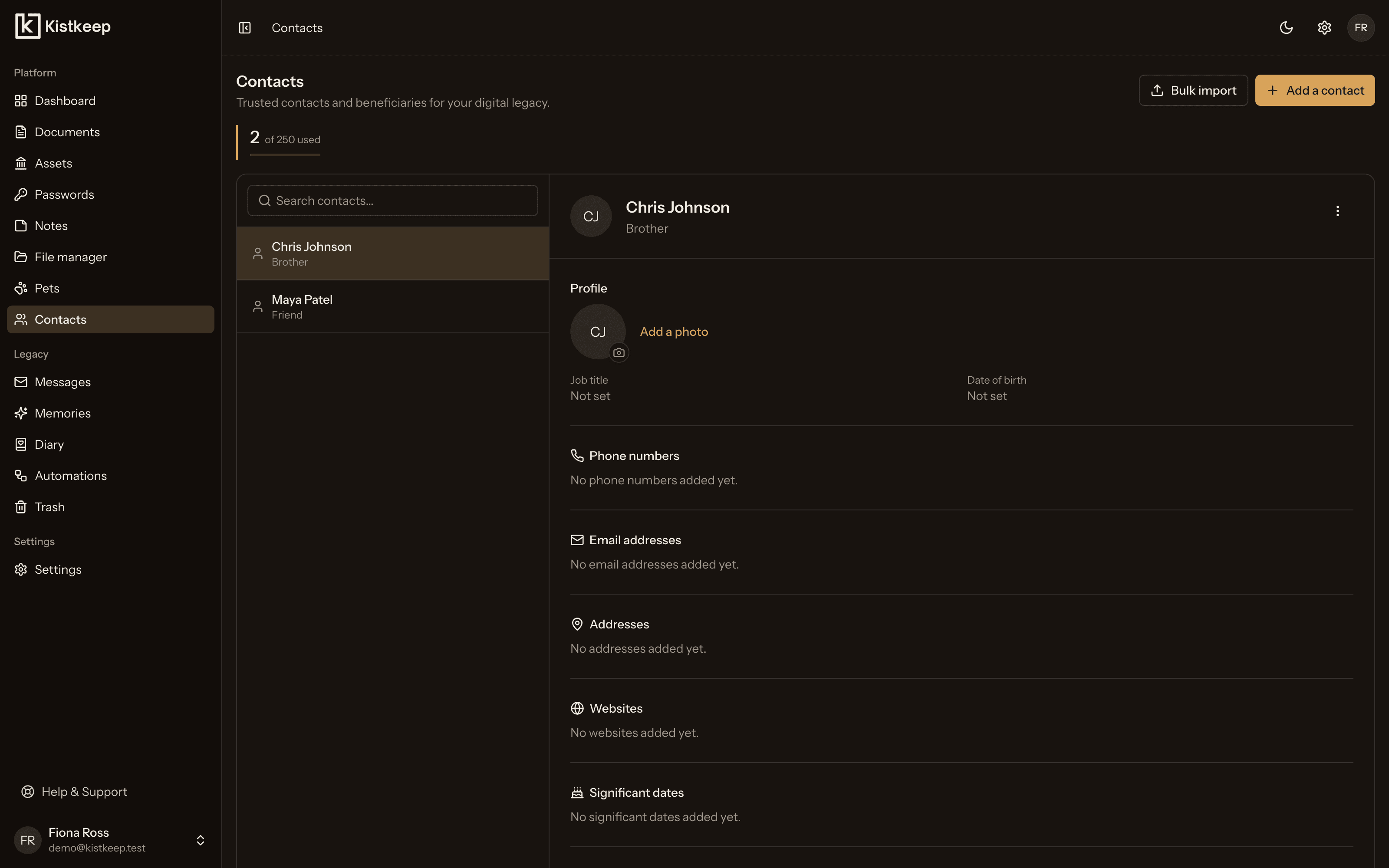
Add the people you trust once, and they'll know exactly what to do instead of guessing from old emails.
How access actually releases
Nothing ever unlocks on a timer alone. Release always requires a human-reviewed report.
- 1
You choose who sees what, and when
Grant each trusted contact living access now, or set a release condition for later. Nothing changes until you say so.
- 2
A report comes in
A trusted contact or reporter lets us know something has happened, with any supporting information they have.
- 3
A human reviews it
Our team checks the report carefully before anything changes. There's no automated "dead man's switch" that fires on its own.
- 4
Exactly what you chose, unlocks
Only the contacts and items you configured become accessible, nothing more.
Living access and future access, in one grant
Share a document with a partner today, and set a separate condition for a wider release later, all from the same trusted contact.
Four kinds of access, for four different situations.
Living access
Share a specific document, password, or memory with someone right now, useful for a partner, a co-owner, or anyone who needs something today, not just after you're gone.
Keyholder enrollment
For zero-knowledge Passwords sharing, a contact enrolls their own encryption keypair ahead of time, so sharing later never has to weaken the zero-knowledge guarantee.
Conditional release
Set access to unlock only once your account is reported and confirmed memorialised, reviewed by a real person, not a countdown timer.
Scoped, per contact
One trusted contact might see your Documents and Memories, another only a single Message. Access is never all-or-nothing by default.
Why we insist on a human in the loop.
It would be technically simpler to just release access after 90 days of silence. We deliberately didn't build it that way.
No single report is enough on its own
A report gets logged and cross-checked. It takes a genuine review, not one email, to change an account's status.
No pure "dead man's switch"
A missed login or an inactivity timer alone never releases anything. That approach is fragile, it fires on a long holiday, a lost phone, or a forgotten password, not just on the event it's meant to detect.
A record of every decision
Every status change is logged, so there's always a clear account of what happened and when, for your family's peace of mind as much as for security.
Choose your people once. Trust the process after.
Start for free, no card required.